When leaders hear “TDD” (Test-Driven Development), it often sounds like an engineering preference — something developers debate.
In reality, testing is a business tool.
If your system is hard to change, if releases are stressful, or if small updates cause unexpected breakage, tests are one of the most reliable ways to reduce risk and increase delivery speed.
This post explains TDD in plain language, and introduces a practical idea for legacy systems:
Use tests to “freeze” today’s behaviour so you can improve the system safely tomorrow.
The business problem tests solve: uncertainty
Software becomes expensive when change becomes uncertain.
Uncertainty looks like:
- “We think it will take two days… but we’re not sure.”
- “We can change it, but it might break something else.”
- “Let’s deploy at night just in case.”
- “Only one person understands this area.”
That uncertainty is what drives:
- slow delivery
- constant firefighting
- cautious teams
- rising costs
Tests reduce uncertainty by turning “we hope it works” into “we know what this change affects.”
What TDD actually means (without the jargon)
TDD is a way of working where developers:
- define expected behaviour (a test)
- implement the smallest change to make it pass
- improve the code while keeping behaviour protected
You don’t need to care about the sequence. What matters is the outcome:
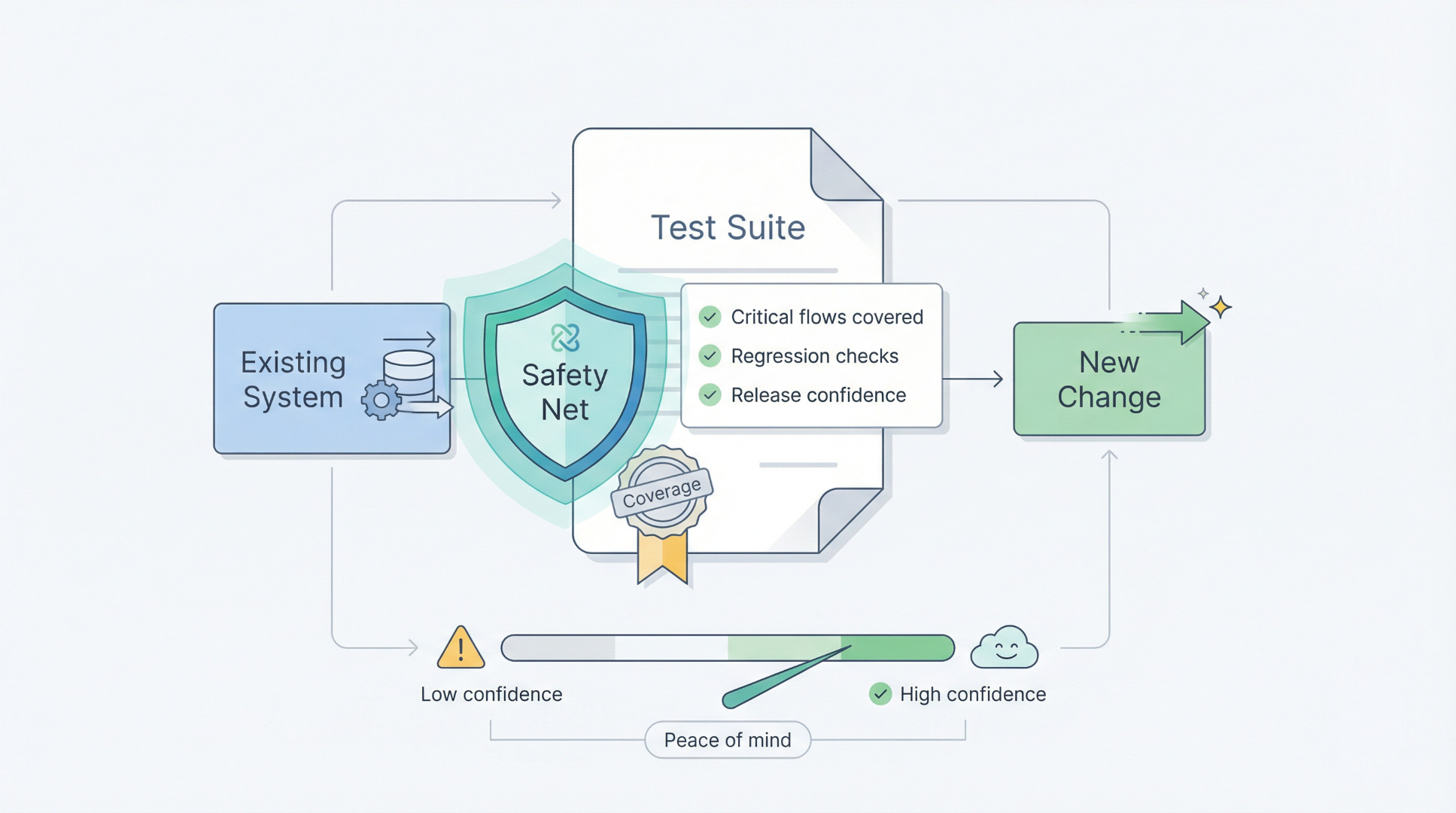
The system gains a safety net that makes change safer and faster.
The “freezing” concept: protect behaviour before you improve it
Legacy systems are rarely perfect. They often include:
- messy code
- unclear rules
- historical “quirks” that customers rely on
- undocumented edge cases
When teams try to refactor without protection, fear is justified:
“If we touch this, something will break.”
This is where tests become a freeze ray.
What “freezing” means
- capture the current behaviour in automated tests
- treat that behaviour as the baseline (even if it’s not ideal)
- refactor safely, knowing you can detect unintended changes
This approach is sometimes called “characterisation tests” — tests that describe what the system does today.
Result: you can modernise safely without a rewrite.
Why tests increase speed (not slow it down)
The common objection is:
“We don’t have time for tests.”
That’s usually a sign the team is paying the hidden tax of an untested system:
- manual regression testing
- long release cycles
- fear-based development
- repeated bugs
- slow onboarding
Tests replace repeated manual checks with repeatable automation.
In mature teams, tests often reduce lead time because:
- bugs are caught earlier (cheaper to fix)
- deployments are less risky
- developers spend less time debugging regressions
- new team members can change code with confidence
The speed comes from safety.
What to test first (the SME-friendly priority list)
You don’t need 100% coverage. You need coverage where risk is highest.
A practical order:
1) Critical business flows
- checkout / payments
- signup and login
- billing and invoicing
- key integrations (e.g., shipping, CRM, accounting)
2) Areas with frequent change
If the business changes it often, protect it early.
3) Areas with high blast radius
Parts of the system where one bug causes many failures.
4) Past incident hotspots
If it broke before, it will break again. Add tests around it.
What “good enough” looks like (for leaders)
As a CEO or business owner, you don’t need to review test code. You need to see that tests are improving outcomes.
Look for these signals:
- releases become more frequent and less stressful
- change failure rate drops (fewer regressions)
- incidents recover faster
- onboarding becomes easier
- estimates become more reliable
A good team can also explain their testing strategy in simple terms:
- what they test
- what they don’t test (and why)
- how tests run in CI before deployment
A simple way to introduce TDD without disruption
If your system has little or no test coverage, trying to “go full TDD overnight” often fails.
A smoother rollout looks like this:
- Adopt “no new code without tests” for new features
- Add freeze tests before refactoring risky legacy areas
- Fix flaky tests immediately (flaky tests destroy trust)
- Make tests run automatically in CI
- Measure outcomes (release frequency, regressions, MTTR)
This turns testing into a practical habit, not a philosophical shift.
The takeaway
Tests aren’t a developer luxury. They’re a business risk-control mechanism.
When you add tests to a legacy system, you’re doing something powerful:
- freezing behaviour
- reducing uncertainty
- making change safer
- unlocking faster delivery over time
If your team is afraid to touch parts of the system, that’s not a culture problem — it’s usually a safety-net problem.
And a safety net can be built.